
Clark Fitz-Gerald (1917–2004) Biography
Videos
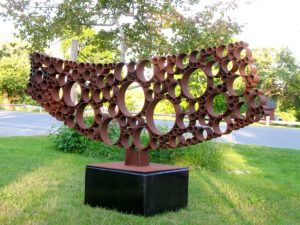
Clark Fitz-Gerald (1917–2004) had already made a name for himself as a sculptor when he moved to Castine, Maine, in 1956. Throughout his long career, Fitz-Gerald achieved regional, national, and international renown for his work, especially his large public sculptures. Many were installed in prominent locations in cities, churches, and universities in the United States and abroad, including Uris Hall at Columbia University, NY; Independence Hall in Philadelphia, PA; and Coventry Cathedral in England.
One of his most notable Maine sculptures, and typical of Fitz-Gerald’s themes, is Continuity of Community, an enormous aluminum mobius strip formerly located at West Market Square in Bangor. Fitz-Gerald has large sculptures located on the campuses of several educational institutions in Maine as well: Maine Maritime Academy in Castine, George Stevens Academy in Blue Hill, Colby College in Waterville, and the University of Maine in Orono. He also made the carved wood ballot box used for public elections in Castine.
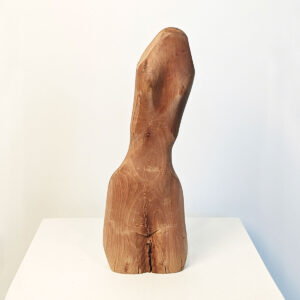
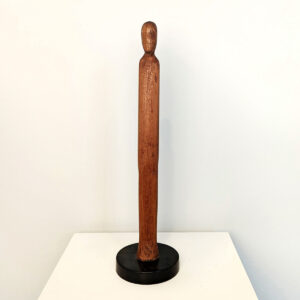
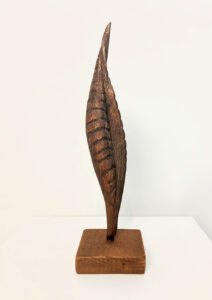
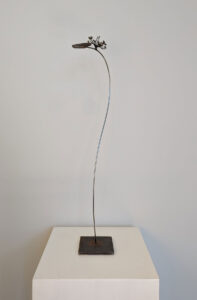
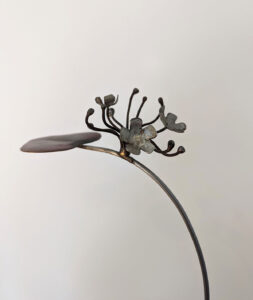
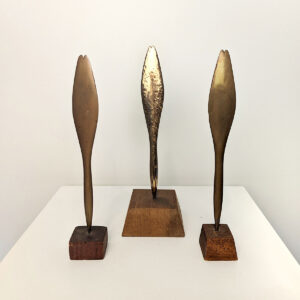
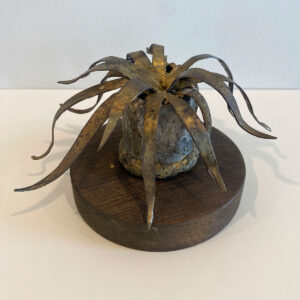
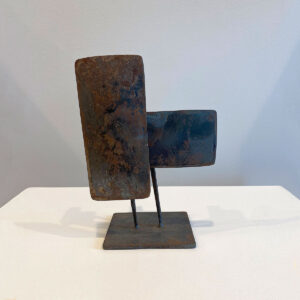
Fitz-Gerald worked in wood, stone, steel, copper, and bronze. The natural world provided him with inspiration, and he was fascinated by the structures of seeds and spores, kelp fronds, and whale vertebrae.
Fitz-Gerald was born in St. Louis, MO, and graduated from the Philadelphia College of Art in 1940. He served in the Ninth Armored Division for nearly all of World War II. After the war, he taught at Phillips Academy in Andover, MA; Washington University in St. Louis; and Beloit College in Wisconsin until 1956. When Fitz-Gerald gave up teaching, he moved to Castine, Maine, with his family to be a full-time sculptor.
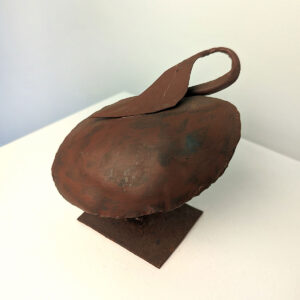
Courthouse Gallery hosted an exhibition of Clark Fitz-Gerald maquettes in 2023.
Maquettes are fascinating works in their own right, conveying an artist’s first realization of an idea. Ranging in size from 3 to 25 inches, this collection of maquettes by Maine sculptor Clark Fitz-Gerald (1917–2004) chronicle the evolution of his fertile imagination. Fitz-Gerald, who lived and worked in Castine, was most inspired by the Bible and myth, science and the natural world, and the human form. The exhibit also highlights several large sculptures. Fitz-Gerald achieved regional, national, and international renown for his work.