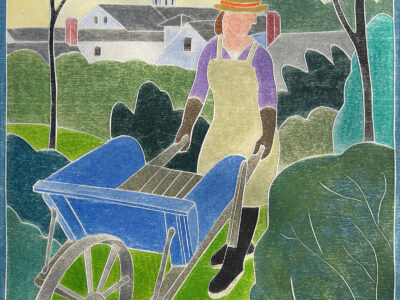
Five Sunflowers, Three Blue Jays, oil on canvas
Stephen Pace bio resume press
Stephen Pace (1918 - ) was at the forefront of the abstract expressionist movement and received critical acclaim for his abstract expressionist paintings during the 1950s. Pace turned to representational painting with abstract expressionist overtones in the 1960’s, and his summer home on Deer Isle provided endless inspiration. His paintings are included in many prominent private and public collections, including the Metropolitan Museum of Art, Hirshhorn Museum and Sculpture Garden, the Whitney Museum of American Art, and National Museum of Art.
Stephen Pace was born in a small town in southeast Missouri on December 12, 1918. When Pace was six, his parents moved to Indiana where his father operated a small grocery store, eventually moving to a farm near New Harmony, Indiana.
Influenced as a boy by his mother’s paintings, Stephen began taking art classes at the Evansville Musuem as a young man. In the late 1930s he studied with Robert Lahr, an accomplished artist living in Evansville who helped Pace achieve a high degree of mastery in drawing and watercolor. With the onslaught of World War II, Pace was called into service. Stationed in England, he painted watercolors of local scenes in his free time. After the war in 1945, Pace returned to Indiana and his studies with Lahr. At the age of 27, he enrolled in the Institute of Fine Arts in San Miguel Allende, Mexico, compliments of the G.I. Bill. Then, on his way back from Mexico after a year of study, Pace paused in a New Orleans bus station. “I knew if I went back to the Midwest they’d put me to work on the farm, so I flipped a coin, heads, New York, tails, San Francisco.” It came up heads and so it happened that Pace went to New York where he studied at the Art Students League in 1948-49. From New York he traveled to Florence in 1950, and at the Academie de la Grande Chaumiere in 1951.
But Pace’s destiny was in New York and Maine. He returned to New York and was drawn into the heady city atmosphere of the late forties and early fifties, the orbit of Abstract Expressionism, and the Hofmann School. Hans Hofmann’s precepts crop up repeatedly in Pace’s work. The importance of the space outside the rectangle, the need for drawing from life because “painting has to come from somewhere,” the dynamic of the push and pull, the structuring with color and the spatial tensions set up between the jostling areas of bright primary colors.
During the 1950s Pace became immersed in the world of the New York School, showing at most of the Whitney annuals and at the artist-run invitations at the Stable Galley. He frequented local artist’s taverns and became good friends with Franz Kline, one of the leading Abstract Expressionists. Pace and other younger abstract expressionists, most of whom were World War II veterans, knew little about the Surrealist phase of Abstract Expressionism with its emphasis on the search for myth and veiling the subjects.

Abstract Expressionism Catalog
BORN
1918 near Charleston, Missouri
STUDIED
Mexico, 1946
Art Students League, 1948-1949
Paris and Florence, 1950-1951
Hans Hofmann, 1951-1952
SELECTED SOLO EXHIBITS IN MAINE
Courthouse Gallery Fine Art, Ellsworth, 2007, ’08, ’09
AJ Buecke Gallery, Northeast Harbor, 2002
Bates College Museum of Art, Lewiston, 1994
Maine Coast Artists, Rockport, 1994
Judith Leighton Gallery, Blue Hill, 1985, ’87, ’89, ’91
Maine Coast Artists, Rockport, 1973
SELECTED SOLO EXHIBITS
Katharina Rich Perlow Gallery, NYC, 1987, ’89, ’91, ’94, ’97, ’98, 2000, ’02, ’07, ’09
Union College, Schenectady, New York, 1999
Courtyard Gallery, Washington, DC, 1996
Evansville Museum of Arts & Science, Indiana, 1992
Weatherspoon Art Gallery, University of North Carolina at Greensboro, 1991
Vanderwoude Tananbaum Gallery, 1991
AM Sachs Gallery, NYC, 1974, ’76, ’78, ’79, ’81, ’83, ’85
Chastenet Gallery, DC, 1981
Barbara Fiedler Gallery, DC 1980, ’81
New Harmony Gallery, Indiana, 1977
Robert Polo Gallery, DC, 1976
American University, DC, 1976
Drew University, Madison, New Jersey, 1975
Bard College, Annandale-On-Hudson, New York, 1975
Kansas City Art Institute, Missouri, 1973
Des Moines Art Center, Iowa, 1970
University of Austin Texas, 1970
Graham Gallery, NYC, 1969
University of California, Berkeley, 1968
Howard Wise Gallery, NYC, 1960, ’61, ’63, ’64
HCE Gallery, Provincetown, Massachusetts, 1956, ’57, ’58, ’59, ’61, ’63
Chicago Arts Club, Illinois, 1962
Kalamazoo Art Center, Michigan, 1962
Columbus Gallery of Fine Arts, Ohio, 1962
Walker Art Center, Minneapolis, 1962
Brandeis University, Waltham, Massachusetts, 1961
Hayden Gallery, Cambridge, Massachusetts, 1961
Dwan Gallery, Los Angeles, 1961
Howard Wise Gallery, Cleveland, 1960
Dilexi Gallery, San Francisco, 1960
Holland Goldowsky Gallery, Chicago, 1960
Washington University, St. Loius, 1959
Poindexter Gallery, NYC, 1956, ’57
Artists Gallery, NYC, 1954
Hendler Gallery, Philadelphia, 1953
SELECTED SOLO PUBLIC COLLECTIONS
American University, Washington, DC
Baruch College, New York
Bowdoin College Museum of Art, Brunswick, Maine
Brown University, Providence, Rhode Island
Chrysler Museum of Art, Norfolk, Virginia
Colby College, Waterville, Maine
Columbus Museum of Art, Ohio
Corcoran Gallery of Art, Washington, DC
Curie Institute, Paris
Des Moines Art Center, Iowa
Evansville Museum of Arts & Sciences, Indiana
Farnsworth Art Museum, Rockland, Maine
Hirshhorn Museum and Sculpture Garden, Smithsonian Institution, Washington, DC
Indianapolis Museum of Art, Indiana
J. Patrick Lannan Foundation, Venice, California
James Michener Collection, Austin, Texas
Jane Voorhees Zimmerli Art Museum, Rutgers, The State University of New Jersey
Metropolitan Museum of Art, New York
Munson-Williams-Proctor Arts Institute, Utica, New York
Museum of Fine Arts, Boston, Massachusetts
National Academy of Design, New York
Nation Museum of American Art (Smithsonian)
Newark Museum, New Jersey
New rleans Museum of Art, Louisiana
Oberlin College Art Museum, Ohio
Olin Arts Center, Bates College Museum of Art, Lewiston, Maine
Phillips Collection, Washington, DC
Portland Museum of Art, Maine
Provincetown Art Association & Museum, Massachusetts,
Union College, Schenectady, New York
University of Denver, Colorado
University of Northern Iowa, Cedar Falls
University of Southern Illinois, Carbondale
University of Southern Indiana, Evansville
Walker Art Center, Minneapolis, Minnesota
Weatherspoon Art Gallery, University of North Carolina at Greensboro
Whitney Museum of American Art, New York
Yale University Art Gallery, New Haven, Connecticut
Maine Sunday Telegram
October 18, 2009
compiled by Bob Keyes
Artist Stephen Pace Selects Courthouse Gallery for Work
Artist Stephen Pace recently selected Courthouse Gallery Fine Art to represent his work in Maine.
Pace artwork at the gallery includes oil paintings, drawings and watercolors with subjects such as Maine scenes, abstracts, horses and nudes.
Gallery owners Karin and Michael Wilkes met Pace and his wife Pam in 2007 when they hosted a farewell-to-Maine exhibition for the artist. The Paces, who spent summers on Deer Isle, left their Maine home to live in his home state of Indiana.
Pace became a prominent member of the New York group of abstract expressionist painters in the 1950s, and he became friends with Franz Kline, one of the leading abstract expressionists. His paintings are included in many prominent private and public collections, including the Metropolitan Museum of Art, Hirshhorn Museum and Sculpture Garden, the Whitney Museum of American Art, and National Museum of Art.
Pace first came to Maine in the early 1950s with a small group of artists. After that initial visit, the Paces frequented the state and finally bought a house in Stonington in the 1970s.
The gallery at 6 Court St., Ellsworth, is open from 10 a.m. to 5:30 p.m. Monday to Saturday and from noon to 5 p.m. Sunday. Call 667-6611 or visit www.courthousegallery.com.

Stephen Pace, shown with his wife Pam, has chosen Courthouse Gallery Fine Art in Ellsworth to represent his work in Maine. With the Paces are gallery owners Karin and Michael Wilkes.
Maine Sunday Telegram
August 26, 2007
combiled by Bob Keyes
Time to Move On
When Steven and Pam Pace depart for good to the artist’s native Midwest, they will be sorely missed — by Maine’s art community and, especially, by the neighbors in Stonington.
Back in 1963, Stephen Pace made a painting that remains to this day one of his lasting favorites.
It’s a picture of a man and woman, both advanced in years, walking side by side down a country lane, their rounded backs facing the viewer. They appear as a solitary, tired couple headed to some distant outpost.
Some 44 years after Pace completed the painting, “Downeast Couple” serves as a symbolic self-portrait of Pace and his wife, Pam. The two, inseparable in the quiet coastal community that they have called their summer home for more than 30 years, are leaving Maine for good this fall.
The University of Southern Indiana in Evansville is building a museum that will include a gallery dedicated entirely to Pace’s work, and it also is giving him studio space so that he may continue painting for as long as he is able.
The Paces – he’s 88, she’s 89 - are moving into an assisted living apartment on campus, where they will receive the care and attention they need as they advance in years. The couple has no children.
“It’s time for us to start saying goodbye,” Pace said during a recent visit to his home in Stonington.
They leave Maine excited about their life ahead, but also with sadness.
The state, and in particular Stonington, has proven to be a wonderful place for the couple.
As a painter, Pace has found numerous points of inspiration, from the lily pond just down the road from his 19th-century sea captain’s home, to the view of the Deer Isle Thorofare from the kitchen window.
Once an active gardener and mushroom hunter, Pam spent numerous hours working in the meadow out back, her husband peering out from his studio overhead, painting her as she turned the earth.
As a couple, the two have been fixtures in the community. They helped establish the Deer Island artist’s association and have been steadfast in their support of their local land trust. In their final summer in Maine, they remain active regularly attending classical music concerts at Kneisel Hall in Blue Hill.
It’s been a good life, Pam Pace said.
“We are so very lucky,” she said. “We couldn’t ask for anything more.”
For Pace, the move to Indiana represents a homecoming. He was born in Missouri, and spent his formative years as in Indiana working on a farm with his family. As a teenager, he had his first exhibition in New Harmony, Ind.
He said it was important for him to get back to his roots while he is able. “It’s my home, and I have family there. It’s time,” he said.
Pace is among the last of a generation of Maine painters who came to the coast when real estate was affordable for artists of modest means. After spending many years as visitors, renters and campers, he and Pam chose Stonington as their summer home because they thought it was the most beautiful place they had ever seen.
They spent the rest of their year in New York.
When Carol Richards and her husband, David, moved to their home in Stonington nearly 30 years ago, they had the Paces as neighbors on one side and the painter Emily Muir on the other.
Muir died in 2003, and now the Paces are leaving.
“They leave a real hole,” said Carol Richards, who with her husband hosted a tearful farewell party in the Paces’ honor last weekend. “In a community way, they are important. I don’t want to face up to their leaving, but I guess I have to.”
A LONG AND ILLUSTRIOUS CAREER
Pace has enjoyed a terrific career, thanks in large part to the work he accomplished each summer in Stonington. Maine has provided him with the time and space to work, and also filled his head with ideas.
Both his abstract and representational works are fixtures in the collections of many major museums in the United States. In Maine, Bowdoin, Colby and the Portland museums own his paintings, and Fryeburg Academy also owns a large selection of work. Through Sept. 16, the Courthouse Gallery in Ellsworth shows several of his paintings in an exhibition titled, “Farewell to Maine.”
Particularly with his representational work, Pace is known for his judicious brush strokes. He doesn’t load his canvas with paint, opting for a lighter, softer approach. His figures are suggestive, and rarely encumbered with detail.
At least two themes run throughout his representational paintings: Female nudes and horses. Both are integral to his expression.
He’s clearly enamored of the female body, and has spent many years painting it in all manner of recline and pose.
The horses go back to his youth. Growing up on a farm, horses represented work, power and mystery.
Pace has painted horses for as long as he can remember. In the Courthouse Gallery show in Ellsworth, the show-stopper is the large painting “Three Black Horses,” from 2006.
Four feet tall and 6 feet across, it hangs on the wall opposite the gallery entrance, and rabs the viewer with its energy. The horses – simple figures, formed with minimal strokes of black paint – appear in a unified trot, heads cocked, ears tuned. A bright blue background frames the horses.
Priced at $30,000, the painting sold quickly, and gallery owner Karen Wilkes said she could have sold it two or three times, based on the level of serious interest among collectors and admirers.
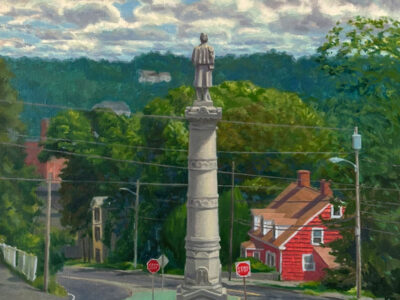
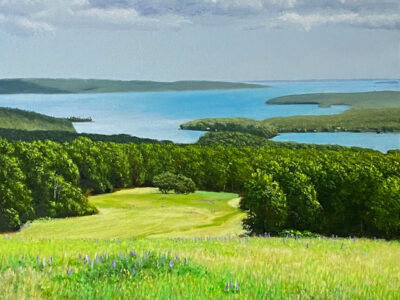
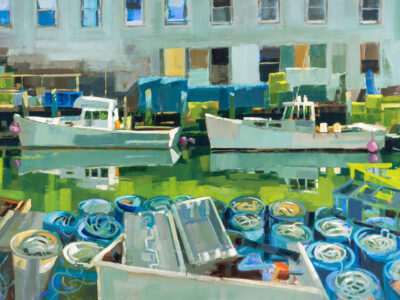
Bruce Brown, former curator at the Center for Maine Contemporary Art, said Pace’s niche has been his ability to convey a sense of his daily life in his paintings, with colorful panache. He paints what he sees – boats in the harbors, the islands in the Thorofare, his gardens out back, Brown said.
Pace distinguishes his work with what Brown calls “his cheerful use of color. So many Maine painters use a lot of gray. But Steve uses fervent yellows and greens, vibrant blues. He takes a celebratory and uplifting point of view of Maine.”
Perhaps because of his agricultural background, many of Pace’s paintings honor his working-class values. Except for the nudes, his figures almost always are toiling at their work, just as Pace has done his entire life. He and his family raised wheat, soy, and watermelons, among other crops.
His figures are wed to the land and the sea, bent over, tired and worn. They are blueberry pickers, lobstermen, clamdiggers.
Pace still works almost every day. He walks with a cane, and his footwork is slow and steady. He has to shuffle through a long back house and then up a precarious set of stairs to get to his second-story barn studio.
He manages OK, but must be careful and deliberate. Each step is a possible hazard.
DRAWN TO ART AT AN EARLY AGE
Pace showed his earlier interest in art as a young boy. He clearly remembers his delight when a grade-school teacher gave him paper without lines for his drawing. The first thing he made was a picture of a horse, which he gave to his teacher in appreciation.
He had his first show at an age of 18, and then launched directly into a career that took him to art school in Mexico on the G.I. Bill – he served in World War II. After the war, he spent time in France, where he had the pleasure of meeting the painter Pablo Picasso through a chance meeting with Gertrude Stein.
One day, he was painting near the Seine River when an American woman approached, admired his work and invited him to meet her famous friend.
The woman was Stein, and she had a friendly relationship with Picasso. She introduced the two, and told Picasso, “I want you to give this boy a critique.”
Picasso showed him around his studio, and spent a surprising amount of time with an impressionable Pace, who at the time was 27.
Eventually, Pace ended up in New York. He fell easily into the Abstract-Expressionist movement, but always felt pulled towards figurative painting.
At the time, everybody told him the figure was dead in modern painting, and urged him to steer clear of realism. But Pace couldn’t resist. He said he felt like a traitor when he began working figurative forms into his work, but he also heard quietly from peers who admired his courage for breaking the mold.
“Why did I change?” he asked. “Because I wasn’t supposed to. I was always an independent thinker.”
He came to Maine at the urging of the wood sculptor Bernard Langlais, a friend from New York who had a summer home here. Langlais advised Pace that real estate was affordable, and the environment welcoming to artists.
Pace came with friends, first to Monhegan and then up and down the coast. He spent many years here, renting and camping, before buying in Stonington in 1973.
Maine has served him well, and he is sad about leaving, he said.
But he cannot stay forever, and the University of Southern Indiana has been generous in its support of him and his career, he said. He already has many paintings on the Evansville campus, and the opportunity to have a museum gallery dedicated solely to his work is hard to resist.
“It’s going to be nice to see all my paintings together in one place,” Pace said.
The Pace’s will retain a presence in Stonington. They have arranged for the Maine College of Art in Portland to acquire their home, as well as the paintings they leave behind.
The college likely will use the Pace home as an artist’s retreat, said MECA president Jim Baker, and the college has agreed to open the house to the public to exhibit Pace’s work.
“We’re delighted,” Baker said. “We’re going to open it up to visitation on a regular basis in the summer. It’s a wonderful property and a great painting studio. It will be a great enrichment to our students, faculty and visiting artists. The Paces deserve a lot of credit for their foresight and generosity.”
In the meantime, the community prepares its farewell.
Carol Richards, the neighbor just down the road, sometimes is too sad to think about what like will be like when the Paces move on. So often, they’re seated together on their porch by the side of the lane that meanders past their house.
It’s going to be strange not having them around, Richards said.
But her sadness is tempered, at least a little, by the work that hangs in their home. The Richardses are great admirers of Pace’s work, and they draw daily joy from his paintings.
“The work has lots and lots of energy in it,” she said. “To me, it comes out of Stephen’s own life. He’s always known what matters to him, which is making art and expressing his reactions to place and people. We’re so lucky that he chose to do that here.”

"Three Black Horses" was painted in 2006 by Stephen Pace and is the centerpiece of his farewell exhibition.